|
|
Posted By IIAW Staff,
Friday, September 18, 2020
Updated: Monday, September 14, 2020
|
By: Godfrey & Kahn Updates
This article was originally published in our September Wisconsin Independent Agent. Read more from our September issue here.
Insurers issuing auto coverage in Wisconsin may want to double check their policies after the court of appeals’ recent decision in Brey v. State Farm Mut. Auto Ins. Co., 2020 WL 3455880 (Wis. Ct. App. June 25, 2019). There, the court found that the
state’s omnibus insurance statute requires carriers offering underinsured motorist (UIM) coverage to provide that coverage even when their insureds have not suffered any bodily injury themselves.
The facts of Brey were relatively straightforward. A father died in an automobile accident. His son sued to recover UIM benefits from State Farm, which insured him under a policy issued to his mother. The father was not insured under that policy,
as he did not live with the son and his mother. State Farm denied coverage because the policy’s UIM provisions required an insured
to suffer “bodily
injury” and the son (who was not involved in the crash) had not suffered any such injury. The son acknowledged those policy terms but argued that they were void and unenforceable because
Wisconsin law does not allow for UIM provisions that require bodily injury of an insured. The trial court sided with State Farm and dismissed the son’s claim. On appeal, however, the appellate court reversed, concluding that State Farm’s UIM terms
were impermissible under applicable Wisconsin statutes.
The case turned on Wis. Stat. § 632.32, a state statute that identifies the minimum coverage that all policies issued in the state must provide. Section 632.32(2)(d) addresses UIM coverage and states:
“Underinsured motorist coverage” means
coverage for the protection of persons
insured under that coverage who are
legally entitled to recover damages for
bodily injury, death, sickness, or disease
from owners or operators of uninsured
motor vehicles.”
According to the court of appeals, this statement unambiguously establishes that UIM provisions in Wisconsin must protect any person who meets three requirements: “(1) the person who makes the UIM claim must be an insured under the UIM coverage of
the policy; (2) that person must be legally entitled to recover damages for bodily injury or death; and (3) that person must be legally entitled to recover from an owner or operator of an underinsured motor vehicle.” 2020 WL 3455880, at ¶ 22.
Because Wis. Stat. § 632.32(2)(d) says nothing about the insured having to sustain bodily injury or death to access UIM benefits, insurance policies issued in the state are not allowed to include that requirement. Id.
State Farm raised a host of other arguments,contending that: the son’s reading of the statute was absurd; that prior Wisconsin case law dictated a result in State Farm’s favor; and that decisions from other jurisdictions suggested State Farm was correct. The appellate court quickly rejected all these arguments, reiterating that the statutory language was unambiguous.
The decision is a good reminder to insurers that, at least in Wisconsin, unambiguous policy language is not always the end of the coverage inquiry.Wisconsin’s omnibus insurance statute always serves as a backdrop to any coverage dispute and can lead to a victory for the insured even when the terms of the policy clearly do not afford coverage. Insurers facing such arguments should seek
counsel experienced with the omnibus statute to help them avoid trouble.
Tags:
commentary from counsel
IIAW
insuring Wisconsin
wisconsin independent insurance association
wisconsin insurance agency help
wisconsin insurance blog
Permalink
| Comments (0)
|
|
|
Posted By IIAW Staff,
Wednesday, September 16, 2020
|

We are back with another Big I Buzz. This week, we are discussing why Hyundai owners are being advised to park outside and a new Century 21 lawsuit. We are also covering some important dates that you'll want to add to your calendar from the IIAW.
Hyundai Warns Owners to Outside, Recalls 180,000 SUVs
Hyundai SUVs could catch on fire because of an electrical short in a computer. Hyundai is telling some SUV owners to park outdoors. With the fire hazard, Hyundai is recalling 180,000 Tucson SUVs in the U.S. from 2019 through 2020. As of September 9th,
Hyundai knew of a dozen engine fires caused by the problem, luckily without any injuries. In addition to the computer shortage, Hyundai says if the anti-lock brake warning light comes on, the SUVs should not be driven and owners should disconnect
the positive cable on the battery. If needed, owners should contact a Hyundai dealer who will provide a loaner vehicle.
For more information on the recall, click here.
Century 21 Lawsuit Against Allianz, Liberty Mutual, Others Just One of Many
According to Insurance Business Magazine, "The battle against business owners and insurance companies over denied business interruption (BI) insurance claims has entered a new stage, as smaller businesses face insolvency and much larger companies prepare
to sue insurers. Bloomberg reported that over 1,000 companies have sued because of denied business interruption claims related to COVID-19.
Read more about the lawsuit here.
IIAW Calendar Reminders
1. Add our October 1st webinar, "Impact of COVID-19 on the Insurance Industry" to your calendar. Starting at 10 a.m. on October 1st, our featured speaker, Dr. Steven Weisbart, Senior Vice President and Chief Economist from the Insurance Information
Institute will cover how COVID-19 has impacted the insurance industry. Dr. Steven Weisbart oversees the Institute's program of economic research and analysis, preparing studies in support of the organization's communications mission, speaking to media
and conducting briefings for member companies, industry organizations and public policymakers. He is a specialist in annuities, pensions, and life, disability and long-term care insurance. Additional, Dr. Weisbart has authored several significant
research papers and articles of insurance issues, including the threat of an avian flu pandemic and the effect of U.S. population on the property/casualty insurance industry.
Register for the webinar here.
2. Our Online Community is launching on November 1st. IIAW's Community will help our members, vendors, sponsors and IIAW staff to connect. In addition to this new benefit, we have a big incentive for members to participate: top contributors of
our Community will receive gifts and prizes that will give back to their local communities, simply for participating!
We are excited to offer our members this free and valuable benefit, and we are eager that together, as a community, we can support your local communities. If you haven't already, read more about how we are supporting you and your local communities in
our September magazine here. If you or someone within your company would like to be a part of our Online Community but don't have an account through our website just yet, please click here. Once we receive your information, we will get an account set up under your company's membership.
3. The first of the Big "I" Wisconsin CE Days is quickly approaching. On September 29th and November 2nd, you can earn up to eight P&C continuing education credits online in just one day. Big "I" Wisconsin CE Days are being offered by the IIAW
in partnership with the Big "I" Virtual University. You can register for as many or as few classes as you'd like, and you can save 25% off with promo code BIGIWICEDAY!
For more news, check out the Action News section of our weekly e-newsletter Big I Buzz.
If you aren't subscribed, click
here to add your email to our emailing list. We hope that everyone has a great rest of their week!
Tags:
Big I Buzz
insuring Wisconsin
wisconsin independent insurance association
wisconsin insurance agency help
wisconsin insurance blog
Permalink
| Comments (0)
|
|
|
Posted By IIAW Staff,
Monday, September 14, 2020
Updated: Thursday, September 10, 2020
|
Matt Banaszynski | CEO of the IIAW
This article was originally published in our September 2020 Wisconsin Independent Agent magazine issue.
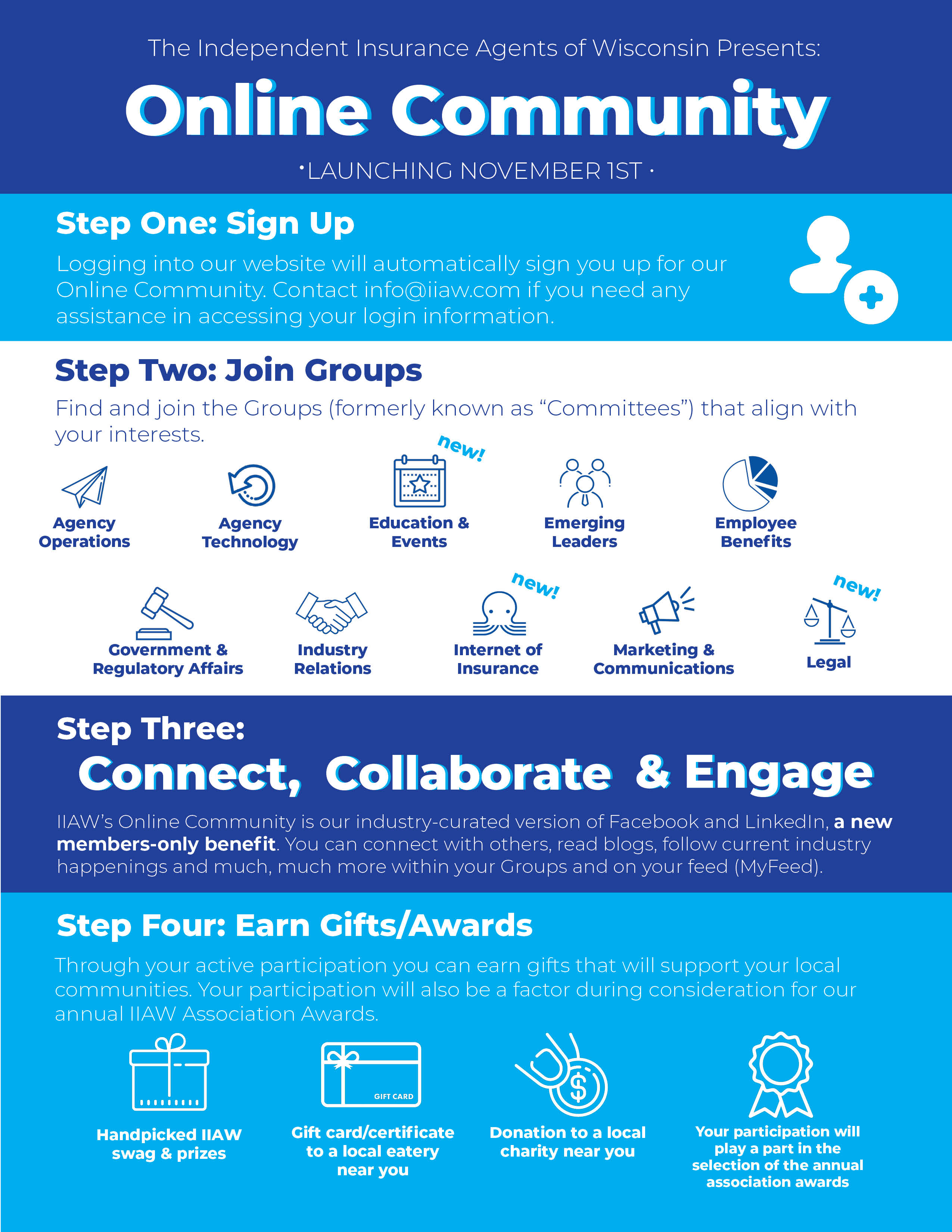
In last month’s issue of Wisconsin Independent Agent, we announced our new platform, the Online Community. IIAW’s Online Community will help our members, vendors, sponsors and IIAW staff connect. This new member benefit will launch on November 1st, and
we have a big incentive for members to participate:
Top contributors of our Online Community will receive gifts and prizes that will give back to their local communities, simply for participating.
Participating in our Online Community is easy. All you need to do is sign up, join Groups, connect collaborate and engage to earn gifts that will give back to your local communities.
Sign Up:
On November 1st our Online Community will go live for all members. Once live, IIAW members can log into their profile on our website, iiaw.com, to access the Online Community. If you or someone within your company would like to join the Online Community
but don’t currently have an account through our website, please contact us atinfo@iiaw.com and we will send you a link to be added as a user under your company’s membership. You can also email us at info@iiaw.com
if you have any questions about logging into an existing account.
Join Groups:
We are moving our current committees online, and they will now be called Groups. Amidst COVID-19, in-person gatherings are hard to accommodate. Instead, we want to continue offering a place for those with like interests to gather together but in a more
attainable way - online. Recently, we opened Group sign up to those who would like to be Thought Leaders (previously known as committee members). Thought Leaders will lead discussions within their Groups and answer any questions that may arise. Prior
to the launch of our Online Community, we will be opening the sign up for those that would like to be generalcontributors of Groups. There are no obligations to join a Group as a contributor, but contributors
can still soak up the information being shared within the Groups they choose to join. When members log into their account on our website November 1st, they will already be a member of the Groups they selected in previous sign-ups.
As we move our current Groups (formerly known ascommittees) online, we are also introducing a few new Group interest areas.
• Legal - This Group will be a source for news and articles. This will be a place to discuss laws and legal implications. Information within this Group will be general in nature, and the forum will not be used to provide personal or
agency-specific legal advice and counsel.
• Education and Events - This Group will shareprofessional development and continuing education opportunities. Members in this Group will learn about industry educational offerings and events.
• Internet of Insurance - The Internet of Insurance User Group will assist users in the utilization and troubleshooting of the IOI, a free platform for members. Members can share questions, comments and connect with Thought Leaders within the Internet
of Insurance space to make improvements to the customer and user experience. Within the Group, members can learn more about the platform and use it to your agency’s advantage. Founders and employees of DAIS, the company that
created the IOI, will be Thought Leaders within this Group.
Connect, Collaborate and Engage
Our Online Community is our industry-curated version of Facebook and LinkedIn. Similar to your favorite social media sites, you can connect with others, read, comment, like posts and much more within Groups and on the feed (MyFeed). Connecting, collaborating
and engaging with other members of our Online Community is the best way to get the most value out of this new member benefit.
Earn Gifts that Give Back
One of the important features of our Online Community is how we will be giving back to local communities. We have created a rewards system to award those who actively participate in MyFeed and Group discussions. Topcontributors
will earn gift cards/gift certificates to local eateries (Wisconsin small businesses), donations to local charities and handpicked IIAW swag and prizes.
Additionally, participation will also play a part in theselection process for IIAW’s end-of-year Association Awards like Agent of the Year, Industry Representative of the Year, Emerging Leader of the Year and
more.
If used to its full potential, our new Online Community will be a great member benefit. Being an active member of our Online Community and its Groups will give members the ability to be a part of just that - an online community of professionals that understand
the industry, customers and values.
We are excited to offer our members this free and valuable benefit, and we are eager that together, as a community,
we can support your local communities too!
Tags:
Insurance Bartender
insuring Wisconsin
online community
wisconsin independent insurance association
wisconsin insurance agency help
wisconsin insurance blog
Permalink
| Comments (0)
|
|
|
Posted By IIAW Staff,
Wednesday, September 9, 2020
|
Happy Wednesday, we hope that everyone enjoyed their Labor Day weekend. In this week's Big I Buzz, we discuss a new study finding that agents can do more to service their clients' needs, Amazon getting FAA approval to deliver packages via drones and an
insurance company who claims to be the first with a work from home discount.
Insurance Company Claims to be the First With a Work From Home Discount
Elephant Insurance, based in Virginia, has announced to offer its policyholders and their spouses discounts for driving less during the pandemic. According to Insurance Business, "In a move that the direct-to-consumer insurance company claims is a national
first, the Admiral Group company doesn't require any telematics devices, just a statement explaining the number of days that their customers now work without commuting to the office." The new discount scheme will start in Indiana and Tennessee from
October 14, Illinois, Maryland, Ohio, Texas and Virginia for policy renewals after October 19th, according to Insurance Business. Learn more here.
Amazon Gets FAA Approval to Deliver Packages By Drone
The Federal Aviation Administration officially designated Amazon an "air carrier" on Monday, paving the way for Amazon to start testing its plans to drop off packages within 30 minutes, according to the New York Post. Amazon will begin testing customer
deliveries for packages under 5 pounds with drones. According to the New York Post, "For Amazon to effectively rely on drones for regular deliveries, it must be able to pre-program the drone's routes and let them fly without human pilots watching
their every move, but US regulations don't currently allow for completely autonomous flights, Bloomberg reported. The FAA would also have to develop a new air-traffic system to track low-altitude drone flights, as well as come up with rules to minimize
the risk of drones striking other aircraft and disturbing human activity below." Read more about Amazon's move to deliver via drones here.
Agents Could Do More to Service Clients' Needs, Study Finds
A study from Nationwide's largest Agent Authority research surveyed 2,600 U.S. independent insurance agents, small-business owners, mid-market business owners, mid-market business owners with fleet vehicles and general consumers between June 9 and June
25 to understand what business owners and consumers value in their insurance relationships. The survey revealed there's a perception gap in the value agents believe they are bringing to their customers, according to Property Casualty 360. According
to the article, "In one example, 95 percent of insurance agents said they are always there when their clients need them, but only 79% of customers felt the same. Similarly, 94% of agents reported they are regularly checking in with their customers;
however, only 69% of customers said they receive sufficient check-ins from their agent."The survey also found that there's a need for expertise in the following lines of business, in addition to property and casualty support:
"•26% of consumers want guidance on retirement planning
• 39% of small-business owners want help with business interruption or disaster planning
• 35% of small-business owners are interested in safety and loss control resources
• 18% of small-business consumers want information on cybersecurity and retirement," according to Property Casualty 360. Read more about the study and its findings here.
For more news, check out the Action News section of our weekly e-newsletter Big I Buzz.
If you aren't subscribed, click here
to add your email to our emailing list. We hope that everyone has a great rest of their week!
Tags:
Big I Buzz
insuring Wisconsin
wisconsin independent insurance association
wisconsin insurance agency help
wisconsin insurance blog
Permalink
| Comments (0)
|
|
|
Posted By Kaylyn Zielinski,
Wednesday, September 2, 2020
Updated: Wednesday, September 2, 2020
|
In this week's Big I Buzz, we are discussing how an exotic dancer received a $8.6 million insurance payout, new PPP rules from SBA aimed at clarifying loan forgiveness and increase in reports of cyberattacks since the start of the pandemic.
Exotic Dancer Gets $8.6 Million Insurance Payout
This news strikes close to home as a Middleton, WI-based insurance company has paid a former exotic dancer, Kailee HIggins more than $8 million over a contentious liability claim. In 2010, the exotic dancer was served as many as 15 shots by the Centerfolds
Club staff (located in Worcester, MA, she was escorted to her car and drove off resulting in a collision with an off-duty police officer. The dancer later sued the club alleging that they were liable for serving her alcohol and letting her drive under
the influence of alcohol. Higgins was awarded $5.4 million initially but it was increased to $8.6 million in consideration of attorney's fees and interest calculations.
New PPP Rules From SBA Aimed At Clarifying Loan Forgiveness
The U.S. Small Business Administration released an interim final rule this week. What has changed in the PPP rules? "The new guidelines state that an owner-employee or a C- or S- corporation who has less than a 5% ownership stake will not be subject to
the owner-employee compensation rule, which caps the amount of loan forgiveness on owner-employee compensation," according to Forbes. Previously, the owner-employee compensation rule stated, "anyone with stake in a company - no matter how small -
that took out a PPP loan was eligible for forgiveness of the lesser of $20,833 or 20.833% of their 2019 compensation or $15,385 or 15.385% if the borrower elected to use an eight-week covered period." Read more about the new rule here.
FBI Sees A 400% Increase In Reports Of Cyberattacks Since The Start Of The Pandemic
Since the start of the pandemic, as more people work from home there has been a rapid increase in cybersecurity incidents among small- to mid-sized business. According to cybersecurity firm DIGIGUARD, here's three steps that small to mid-sized businesses
can take to protect their systems from cyber intrusion,
"• Secure and update network perimeter defenses along endpoints taht access the network, such as computers and mobile phones
• Back up and secure business data for recovery in the event of a cyberattack or system failure
• Train employees to recognize and avoid cyber threats like phishing attacks and malware"
Because there has been a 400% increase in reports of cyberattacks, ransomware attacks are increasingly targeting small- to medium-sized businesses. Read more here.
For more news, check out the Action News section of our weekly e-newsletter Big I Buzz. If you aren't subscribed, click
here to add your email to our emailing list. We hope that everyone has a great rest of their week!
Tags:
Big I Buzz
insuring Wisconsin
wisconsin independent insurance association
wisconsin insurance agency help
wisconsin insurance blog
Permalink
| Comments (0)
|
|
|
Posted By IIAW Staff,
Thursday, August 27, 2020
|

By Chris Boggs | CPCU, ARM, ALCM, LPCS, AAI, APA, CWCA, CRIS, AINS, is IIABA's Executive Director Risk Management and Education
Focus is key! From an errors and omissions (E&O) perspective, agents cannot lose focus during this disrupted work setup. Working from home does not change the fact that all procedures and processes that apply in the home office also apply at the "home"
office.
From now until we are released from our lockdown and able to return to normalcy, we must remember that every action or inaction has consequences - good or bad. There are a few simple rules or guidelines agencies and agents should follow during this unprecedented
moment in time to avoid or lessen the effects of an errors and omissions claim.
Rule #1: Document! Document! Document!
Franklin D. Roosevelt may be the most famous cheerleader of all time (other than Toni Basil). It’s true. As a student at Harvard he was a cheerleader for home football games. Some years later, he led the country through World War II, using his fireside
chats to calm America’s tensions and fears. He was still a cheerleader. Given the tensions and even insecurity some feel as we live through our current pandemic panic, we need a cheerleader and simply a leader to keep us calm and to keep us focused.
Roosevelt was a forward thinker; he actually wrote a cheer to help agents remember Rule #1 for working from home. Are you Ready? OK! Document day; Document night; Document left; Document right; Document, document, document! Yea, document! OK, so maybe
this isn’t a Roosevelt original, in fact it’s a pure fabrication – but the point is no less relevant. Even when working in a non-traditional space, remember to document every conversation, text, email, yell, whatever. When it involves a client, document
it.
Rule #2: Keep the Schedule You Had at the Office
No, this isn’t limited to “open” and “close” times; this refers to regularly scheduled staff and team meetings. Not being in the same room is no excuse for ending activities necessary for the successful operation of the agency. Basically, if it was important
for the agency and the teams leading up to the disbursement, it still is.
“We have our normal commercial lines staff meeting on Mondays at 10. We go over new and renewal business, lost accounts, cancellations, claims, accounts with issues, industry news and current events and any issues that popped up that need to be addressed,”
reports one agent. “We also have individual team meetings for personal lines and employee benefits.”
Another agent tells us, “Zoom is our new contact method for client meetings and for meetings with staff. We have ‘Town Hall’ meetings every Friday afternoon with all employees; producer meetings every Monday morning; the commercial lines, personal lines
and employee benefits teams have staff meetings once per week; and the Leadership team has probably had Zoom meetings 10 times over the past three weeks.” E&O Exposures: Increased When Working from Home? PROFESSIONAL LIABILITY. Keeping everyone connected
and informed is paramount when everyone is in the office. But when there is no office “atmosphere,” keeping everyone connected and informed is even more important.
A cornerstone of these meetings should be policies and procedures. Pick one errors and omissions topic and remind every person on the call of the office procedure relevant to that topic. This conversation does not have to take more than three or four
minutes. One topic, one reminder - this keeps the staff on course.
Rule #3: Keep "Them" Close and Informed
Your clients and your carriers are living in this same altered reality in which you are living. Any sense of normalcy is welcomed.
Stay in contact with your clients and keep them informed. As their agent, your insureds will likely turn to you more now than in the past. News reports, press releases and the problem of “someone told me” will certainly spread a lot of misinformation
among your customer base.
To manage and hopefully end the spread of misinformation, you need to know the correct information. Know policy language, know the carrier’s processes and plans, know the insurance regulations, and know when to say “No.” From an E&O perspective:
- Never answer a coverage question without the insured's policy in front of you. Even the most "common" policy has "uncommon" endorsement you may forget were attached.
- Not every carrier is the same; in fact, no carrier is like any other carrier. Know the underwriting guidelines and what can and can't be done for the client. Don't promise something until after you know it can be delivered.
- Don't practice outside your licensure. As a licensed agent, your job is to procure and manage the insurance program with and for the client. You are not licensed or qualified to offer an opinion on contract wording or other legal matters.
Remember also, you are not licensed to help complete federal forms unrelated to insurance. Direct the insured to the proper professional; don’t create an E&O problem by being too helpful.
Your underwriters need to hear from you as well. In fact, they may want to hear more from you now than in the past because they may be lonely. Kind of a weird thought, but many underwriters are used to working in an office with other humans; being alone
is hard on them. Even field underwriters who normally work at home are accustomed to meeting with and talking with agents face to face on a regular basis.
Keep the underwriters informed when something new is learned about a client. Talk with them about unusual situations or unusual requests made by the insured. You and your underwriter may be able to find creative solutions that best serve your client and
the carrier. You also want to know what the carriers are thinking and planning in regard to renewals. Are there new endorsements coming that may limit coverage? Find out during these “keeping in touch” calls, it may help avoid an E&O situation.
Many insureds are concerned about money as a result of state-mandated lockdowns. Commercial lines clients may essentially be out of business, personal lines clients may be out of a job; the result is the same for both clients - fear. The fear of having
to choose among feeding their family, paying the bills or paying insurance premiums. When this question arises, this is a conversation that involves both your insured and your insurance carrier. Everyone must be informed.
When the specter of policy cancellation appears, address it directly and appropriately.
- Know if your state has enacted any temporary measures regarding cancellation for non-payment. Current information is available here.
- If a regulation is in place, advise your client of the regulation and give them a copy of the wording.
- Advise your insured to never cancel any policy and document the conversation.
- If the insured insists on cancelling any policy, make use of a cancellation notification letter.
Rule #4: Recognize Potential Weaknesses
“One of my E&O concerns is our new producers and what they are telling prospects and customers. Are they writing the correct coverages on new and renewal accounts? We do have mentors for each of the new producers and we hope nothing is falling through
the cracks,” reports one agent.
This agent’s concern is probably the same as many other agents, what are the new, less experienced employees doing? Are coverages being written correctly? Are questions being answered correctly? Do they know and understand the agency procedures well enough
to properly protect the client and us?
These are valid concerns. One drawback of working from home is the loss of “quick confirmation.” Generally, employees have the ability to quickly check their understanding of the policy language, an underwriting guideline or anything else with someone
in the office; all they have to do is walk to someone’s desk and ask for help.
Well, unless there is an open-line Bat Phone there is no one to ask and get an answer from quickly. Emails, instant messages and/or phone calls have to be made to get the answer. Some agents feel like the insured is unwilling to wait for an answer and
will just “wing it” and hope they are correct, or that if they are wrong, nothing will happen to highlight the error.
Make sure every employee understands this is NOT OK. It is never acceptable to “wing it,” and the current situation does NOT change that fact.
Train every employee, not just the new employees, that it is acceptable for them to explain to the client that they don’t know the answer or that they want to confirm the answer. Rarely is the insured unwilling to wait for a correct answer. “Mr. Insured,
that is a great question. Let me confirm the answer and call you right back. I would rather give you the correct answer the first time.”
Then, do what you promised. Get the answer as quickly as possible and call the insured back as soon as possible. The insured will be satisfied and you will be able to sleep well. (Oh yeah, don’t forget to document the conversation and follow up in writing
with the insured.)
Last Rule: Don't Forget Your Upbringing
As my kids got old enough to go out with friends and on their own, I would always say, “Remember who you are; whose you are; and who you represent.” My goal was to impress upon them that their actions affected more than just them.
Every employee’s actions affect the agency – positively or negatively. It is necessary to remind your employees, often, that what they do matters; not only does it matter to them, it matters to everyone in the office.
Train them, retrain them, and train them some more on E&O avoidance. Make it part of the fabric of the agency. Make it important. When it is important to the leadership, it is important to everyone.
Now that they are “out on their own,” in some respects, training will show. That statement should bring you comfort, not scare you. If it scares you, let’s talk.
Learn more about Big "I" agency risk management here.
Tags:
E&O Risk Management
insuring Wisconsin
remote work
wisconsin independent insurance association
wisconsin insurance agency help
wisconsin insurance blog
work from home
Permalink
| Comments (0)
|
|
|
Posted By IIAW Staff,
Wednesday, August 26, 2020
|
Happy Wednesday! This week we are discussing our upcoming webinar series, traffic tickets raising car insurance rates and Progressive's pet insurance benefit for employers through PetsBest.
Agency Leadership Webinar Series
Tune into our Agency Leadership Webinar Series starting October 1st. Our webinar series is a free member benefit.
Thursday, October 1 at 10 a.m. - Impact of COVID-19 on the Insurance Industry
Thursday, October 22 at 10 a.m. - State and Federal Election Preview
Tuesday, November 10 at 10 a.m. - State of the Current Economy & the Next 5 Years
Friday, December 4 at 10 a.m. - E&O Claim Trends
Tuesday, January 19 at 10 a.m. - Agency Technology
See the schedule, register for the webinars and learn more about the featured speakers here.
Common Traffic Tickets That Raise Car Insurance Rates the Most
Certain traffic tickets may not cost much, but the impact on insurance premiums can be significant. According to The Zebra (a leading insurance comparison site and independent source for industry resource and consumer education), "Drivers who get ticketed
for forgetting to turn on their lights pay an average of $68 more per year for car insurance than drivers without any violations on their record. Drivers who get a ticket for speeding in a school zone will see an average insurance increase of $342
per year."
Here are some of the riskiest tickets that can more than double an existing auto premium:
Reckless Driving - Average rate increase of 67 percent
Driving with a Suspended License - Average rate increase of 67.4 percent
Refusing a Breathalyzer - Average rate increase of 69.8 percent
DUI - Average rate increase of 71 percent
Racing - Average rate increase of 73.1 percent
Hit and run - Average rate increase of 78.3 percent
Read more here.
Progressive Teams with PetsBest for New Pet Insurance Benefit
"Progressive has offered consumer pet insurance plans to dogs and cats owners through PetsBest through 2009. Now, Progressive is using that offering as a springboard as they enter the voluntary benefits market for the first time. new employer clients
will be able to offer a pet insurance benefit through Progressive." according to Employee Benefit Adviser. Learn more about the pet insurance benefit through Progressive and its partnership with PetsBest here. For more news, check out the Action News section of our weekly e-newsletter Big I Buzz. If you aren't subscribed, click here to add your email to our emailing list. We hope that everyone has a great rest of their week!
Tags:
Big I Buzz
insuring Wisconsin
wisconsin independent insurance association
wisconsin insurance agency help
wisconsin insurance blog
Permalink
| Comments (0)
|
|
|
Posted By IIAW Staff,
Monday, August 24, 2020
Updated: Tuesday, August 18, 2020
|

By: Chris Boggs | Big "I" Virtual University Executive Director
Company Bulletin 2020-15 issued June 8, 2020, by the Illinois Department of Insurance (IDOI) threw key provisions of the business income policy out the proverbial window. In its
bulletin, the IDOI addressed the recent riots and how thedepartment expects insurance carriers to respond.
In a press release accompanying the bulletin, the IDOI and Governor’s office stated: “Damage to businesses followsdramatic declines in revenue for businesses across the state as a result of COVID-19 pandemic. As the state works with
businesses to recover, the governor’s office and IDOI have made expectations clear to insurance companies.”
To clarify the IDOI’s expectations, the bulletin states, in part:
The Department hereby requests that all insurers licensed or authorized to transact insurance business in this Stateimmediately implement the following protective measures:
• To the extent business interruption provisions are included and operative under a policy, insurers should base payouts on business activity levels that eliminate the impact of COVID-19.
Note the highlighted phrase. The IDOI is directing theinsurance carriers to pay losses they do not owe. Why do the carriers NOT owe the loss when coverage is written using Insurance Services Office (ISO) or similar language? Because both business income policies,
CP 00 30 10 12 - Business Income Coverage Form-With Extra Expense and
CP 00 32 10 12 - Business Income Coverage Form-Without Extra
Expense, apply the same methodology for determining
business income loss payments, specifically both policies state:
3. Loss Determination
a. The amount of Business Income loss will be determined based on:
(1) The Net Income of the business before the direct physical loss or damage occurred;
(2) The likely Net Income of the business if no physical loss or damage had occurred, but not including any Net Income that would likely have been earned as a result of an increase in the volume of business due to favorable business
conditions caused by the impact of the Covered Cause of Loss on customers or on other businesses;
(3) The operating expenses, including payroll expenses,necessary to resume “operations” with the same quality of
service that existed just before the direct physical loss ordamage; and
(4) Other relevant sources of information, including:
(a) Your financial records and accounting procedures;
(b) Bills, invoices and other vouchers; and
(c) Deeds, liens or contracts.
Paragraph 3.a.(2) in both ISO’s business income policies state that the loss is partly determined based on the LIKELY Net
Income. If the business was considered “non-essential” and was thus closed in an attempt to control the spread of COVID-19, the
likely Net Income is zero. No dollars were being earned.
IDOI is strongly suggesting (maybe requiring) insurancecarriers to ignore this and similar policy language. Carriers
appear to be expected to pay business income claimsresulting from riots and looting as if the business was fully operational.
The Independent Insurance Agents and Brokers of America (Big I) addressed the issue of covered losses occurring during the period of shut down as a result of COVID-19 in late March. As was specified in this article, the only business income loss any
carrier should owe is the amount of income lost AFTER the business COULD have opened but was not able to because of the property damage.
Any carrier paying claims not supported by policy language is doing so in violation of the principle of indemnification, the cornerstone of property insurance. Paying losses unsupported by policy language puts the insured in a better position than
they would have been had these losses not occurred. This is a slippery slope carriers need to stay off.
Tags:
business income
COVID-19
DOI
insuring Wisconsin
virtual university
wisconsin independent insurance association
wisconsin insurance agency help
wisconsin insurance blog
Permalink
| Comments (0)
|
|
|
Posted By IIAW Staff,
Friday, August 21, 2020
Updated: Tuesday, August 18, 2020
|

By: Richard F. Lund, JD | President, Americas Property and Casualty, SwissRE Felix has decided to sell his house and contacts Mary, an independent insurance agent, who he knows has been in the community for many years. Felix asks Mary if she knows of a good real estate agent who can help him. Mary tells him she knows the perfect person, Rusty Nail at Nail Real Estate. Mary doesn’t hear from Felix until about 3 months later when Felix calls her and relates the following story. Rusty advised Felix that an open house would be a good way to show the house to prospective buyers and that it would best for Felix to be out of the house during that weekend. When Felix returned, the interior of the house had been destroyed. Felix learned that Rusty had a party that left Felix’s house in shambles with damages in excess of $10,000. When Felix approached Rusty to pay for the damages, Rusty responded that he in fact was not a real estate agent, that his license had been suspended for 3 years and he had no insurance to cover the damages. Felix blamed Mary’s recommendation of Rusty for the damages and threatened to file suit against her. Mary then reported the claim to her errors & omissions carrier. Is this covered? The Swiss Re Insurance Agents Errors and Omissions policy provides coverage for claims arising out of “professional services” rendered to others. “Professional Services” is defined to include activities as a managing general insurance agent, general insurance agent,insurance agent or insurance broker. As a general rule, referring a customer to a third person or entity unrelated to the insurance products provided by the agency is not considered “professional services” under the policy. In this case, the claim for negligent referral against Mary would not be covered under her insurance agent’s errors & omissions policy. What can you do to protect yourself in this type of situation? There are several options. 1. Risk avoidance - decide you are not going to continue providing referrals 2. Risk mitigation - continue providing referrals, but offer several names and be sure to include a statement or statements that specifies the scope and limits of what you are providing; for example, that the person getting your referral should look into the qualifications of anyone they choose to use to be sure their needs and requirements are met. You should consult with an attorney licensed in your state as to the use of and the specific language of a disclaimer and the legal effect of such language. Unfortunately, sometimes it just doesn’t pay to be nice, and in fact it can cost you.
Tags:
errors and omissions
insuring Wisconsin
wisconsin independent insurance association
wisconsin insurance agency help
wisconsin insurance blog
Permalink
| Comments (0)
|
|
|
Posted By IIAW Staff,
Thursday, August 20, 2020
|
In this week's Big I Buzz, we are discussing new changes coming to IIAW Committees, how agents can adapt to the "new normal" and how major US insurers see lower coronavirus costs than expected.
New, Exciting Changes to IIAW's Committees

The IIAW Committees are more important than ever! With the launch of our Online Community on November 1st, we will be moving our current committees online, and committees will now be called "Groups".
Group participation in our Online Community with be recognized and awarded! Earn gift certificates to your hometown restaurants, donations for your favorite local charity, IIAW swag and prizes.
If you're new to the Association or have thought about joining a committee in the past, now is the time to join as a Thought Leader on our new Online Community. A "Thought Leader" is an industry leader for topics within a Group. If you want to join a
Group without being a Thought Leader, you can! Three is no limit to the number of Groups you can be a member of. The invitation to join a Group as a member and not a Thought Leader will be sent at a later date. Learn more about the Online Community,
its Groups and Thought Leaders here.
Digital, Accelerated: How Agents Can Adapt to the New Normal
With easy, instant, online buying experiences now the norm, consumers have come to expect the same from every company they do business with. COVID-19's impact on our everyday normal has accelerated the shift towards digital. Foundational tools for a digital
shift internally include agencies setting up a virtual private network (VPN), investing in a cloud-based agency management system (AMS) and also, setting up a Voice over Internet Protocol (VoIP) phone system to let your staff make and receive calls
from your office number even if they are working from home. Read more from Independent Agent here.
Major US insurers see lower coronavirus costs than expected
A new Q2 2020 report of five insurers that have large US operations shows what they call a 'relatively modest $2.5 million blow'", according to analysts cited by Reuters. "The $2.5 billion loss is lower than was initially feared and the loss has been
absorbed by the industry without insurers resorting to more bad tidings in the form of major claims just around the corner, considering that the coronavirus continues to spread," according to Insurance Business Magazine.
For more news, check out the Action News section of our weekly e-newsletter, Big I Buzz. If you aren't subscribed, click here to add your email to our mailing list. We hope that everyone has a great rest of their week!
Tags:
Big I Buzz
insuring Wisconsin
wisconsin independent insurance association
wisconsin insurance agency help
wisconsin insurance blog
Permalink
| Comments (0)
|
|

 Blog Home
 All Blogs
 RSS
RSS